
LDRT — real-time bench controllers
Three compact Linux-based controllers — entry-level to high-performance — with deterministic control down to 100 µs, built-in EtherCAT master, up to 16 CAN FD channels and high-speed data acquisition. One toolchain across the family.
Three models, one toolchain
Pick the controller that fits the bench — everything you build (models, configurations, test sequences) moves between them unchanged.
| Model | LDRTDaq‑h1 | LDRTDaq‑m1 | LDRTDaq‑e1 |
|---|---|---|---|
| Tier | High-performance | Mid-range | Entry-level |
| Min control cycle | 100 µs | 250 µs · down to 100 µs* | 500 µs |
| Max real-time logging | 100 ch @ 10 kHz | 500 ch @ 1 kHz | 100 ch @ 1 kHz |
| CAN/CAN FD channels | up to 16 | 2 or 4 | 2 |
| EtherCAT master | ✓ | ✓ | ✓ |
| Typical use | HiL & high-speed benches | Engineering & research benches | Education & production test |
* Application-dependent — the achievable minimum cycle depends on I/O count, model complexity and logging load. Ask an engineer to confirm the cycle time for your application.
LDRTDaq-h1
100 µs control · 100 ch @ 10 kHz logging · up to 16× CAN/CAN FD · expandable I/O — for HiL and high-speed benches.
Full specs →LDRTDaq-m1
Control from 250 µs (down to 100 µs) · 500 ch @ 1 kHz · EtherCAT master · OPC UA — for engineering and research benches.
Full specs →LDRTDaq-e1
500 µs control · 100 ch @ 1 kHz · 2× CAN/CAN FD · EtherCAT master — for education and production test.
Full specs →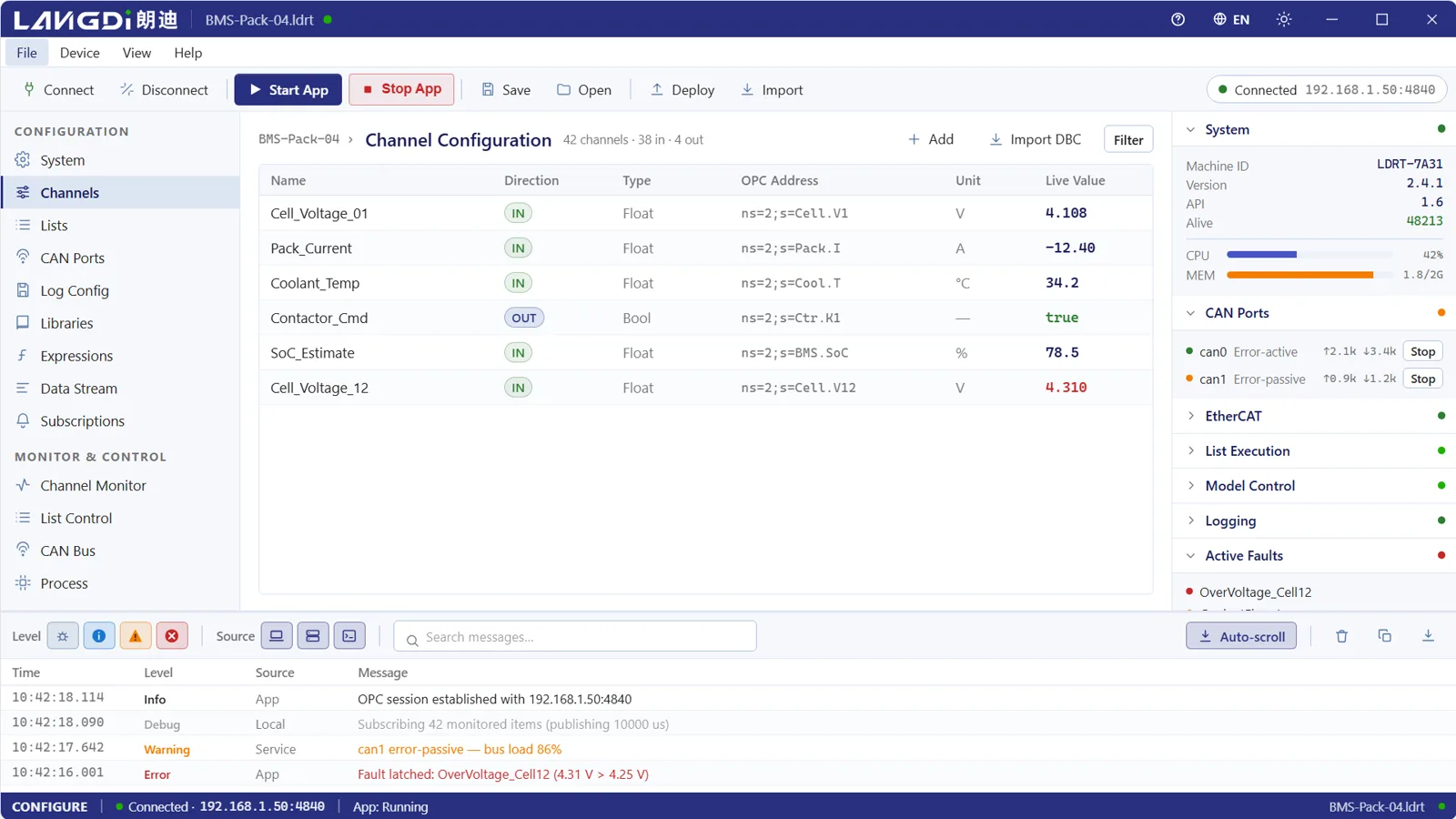
One tool from development to monitoring
The LDRT Workbench desktop suite covers the whole controller workflow:
- Develop — use the built-in AI code agent to develop custom bench control logic.
- Configure — system variables, CAN, EtherCAT, models, logging and test sequences.
- Validate — every configuration is checked before it reaches the bench, so mistakes surface on your desk — not on the rig.
- Deploy — one-click deployment from the desktop to your LDRTDaq controller.
- Monitor — real-time variable monitoring with interactive tables and graphs.
Deterministic control. High-rate streaming.
The real-time core runs your control loop untouched by anything else on the box — while a built-in streaming publisher sends live channel data out to as many subscribers as your bench needs.
- High-speed data streaming — every channel published live off the controller, so dashboards, loggers and analysis tools see the bench as it runs.
- Publish / subscribe interface — subscribe from LDEV-X, the Workbench, or your own Python, C++ or C# client.
- Many subscribers, one stream — monitoring, recording and post-processing run in parallel without loading the control loop.
- Isolated from the loop — streaming and logging never compete with the deterministic core for timing.
Describe the bench — the agent sets it up
The built-in AI agent understands how a Langdi bench is put together, so you can ask for what you need in plain language and get a valid, ready-to-deploy configuration back — no scripting required.
Channels & sensors
Set up measurement channels, sensors, setpoints and calibration for your device under test.
Control models
Build the control and signal-processing chain that runs your bench.
Computed values
Derive efficiency, power or any other value from live measurements with maths and logic.
Data recording
Choose what gets recorded, at what rate, and what starts and stops it.
Test profiles
Create automated run profiles — ramps, sweeps, holds and endurance cycles.
CAN / CAN FD
Bring bus signals onto the bench — import your DBC and map messages to channels.
EtherCAT network
Scan the network with the built-in master, then map I/O modules and drives to channels.
Live data streaming
Decide which channels stream off the controller and what each connected tool receives.
Reusable building blocks
Save proven control modules once and reuse them across every bench in the lab.